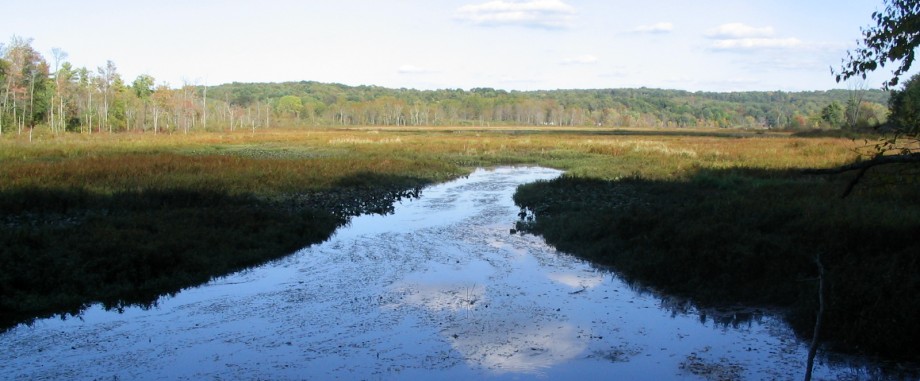
Indoor-nesting Peregrines? Yes- only in Erie, PA!

Ok, maybe “indoors” isn’t quite the right term for their preferred nesting ledges, but this location is truly unusual and definitely under a roof. A large roof, sitting on top of very tall walls. About ten stories tall. We’re talking about a drydock facility on Erie’s bayfront, where very large ships are built and repaired.
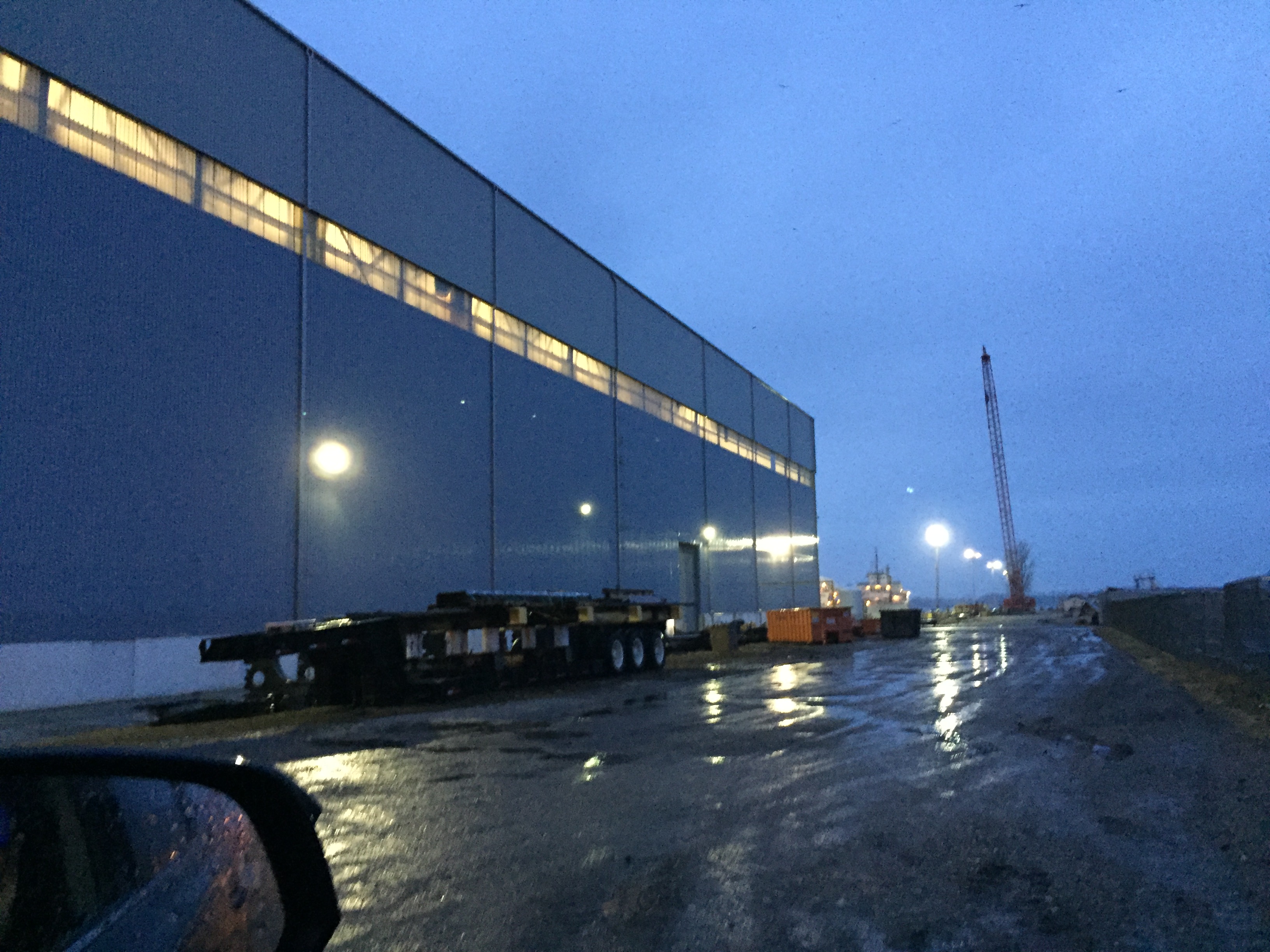
The exterior of Donjon Shipbuilding & Repair (
https://www.donjonshipbuilding.com/ ) as we prepare to enter for our visit on March 29th, 2019.
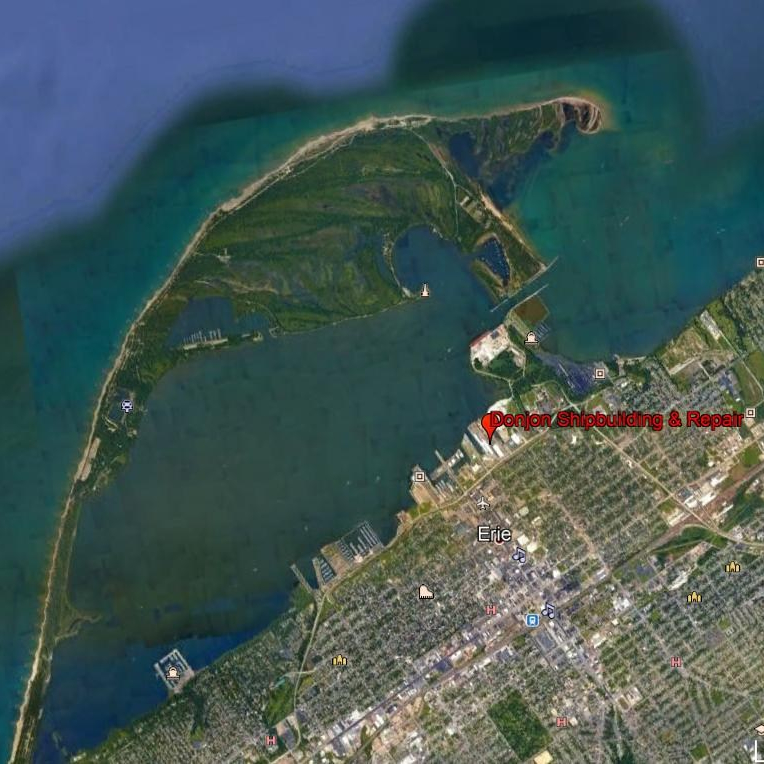
This has been home to a nesting pair of Peregrine Falcons since about 2012. We’re not sure exactly which year they first adopted it; the workers knew the birds were there, but didn’t know how rare they were or that it was highly unusual to be hosting royalty of the avian world in an active industrial facility. They did enjoy the way the falcons kept the gulls in check, and noticed the piles of feathers and other evidence of the falcons’ prey. And then in 2013, a young falcon got in trouble when it first fledged, as often happens, so the workers called Tamarack Wildlife Center for help. Tamarack was amazed to be treating a locally hatched young Peregrine, of course, and then the word was out. Every spring since then, members of Presque Isle Audubon Society, Tamarack Wildlife Center, Audubon PA, and now Erie Bird Observatory make a trip to Donjon’s to check out the status of the birds there.
This image has an empty alt attribute; its file name is 2019-03-29-07.17.28.jpg
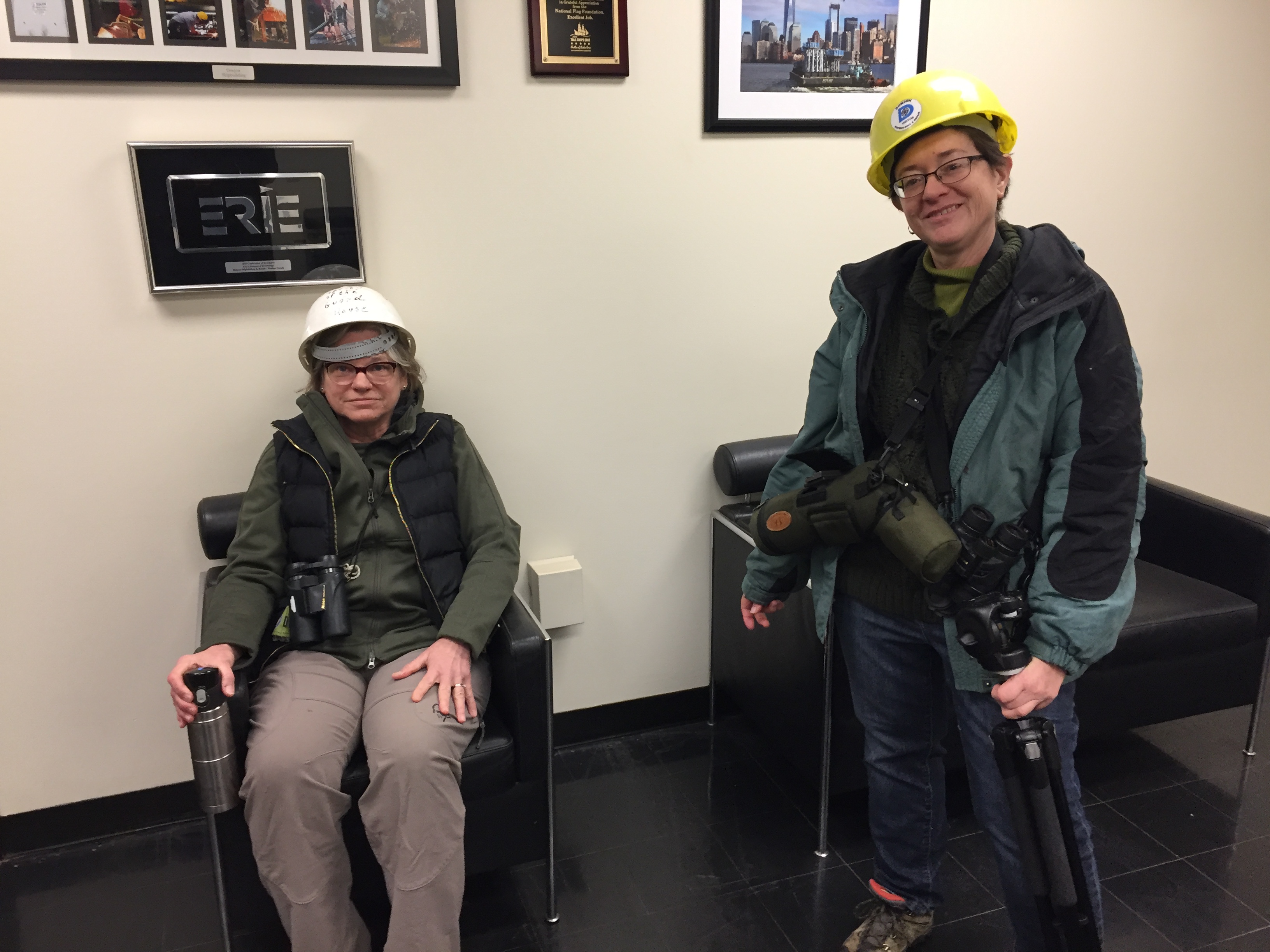
Mary and I with our hardhats on.

So, kicking off the 2019 season, Mary Birdsong, Mike Plyler and I met at 7 AM on Friday, March 29th, at the entry gate, and signed in. This is private property, and an industrial work site, so we also sign “hold harmless” waivers and are issued hard hats. Fortunately, the management at Donjon is very supportive of the falcons, and is proud to be their host. After all, the birds came to them! And they kindly let us come in a check up on them a few times a year.But this is not a publicly accessible location for observing Peregrine nesting. Note: The birds can easily be observed from adjacent public access areas, such as the Blasco Public Library parking lot, perching on high spots such as the Blasco smokestack or flying by.
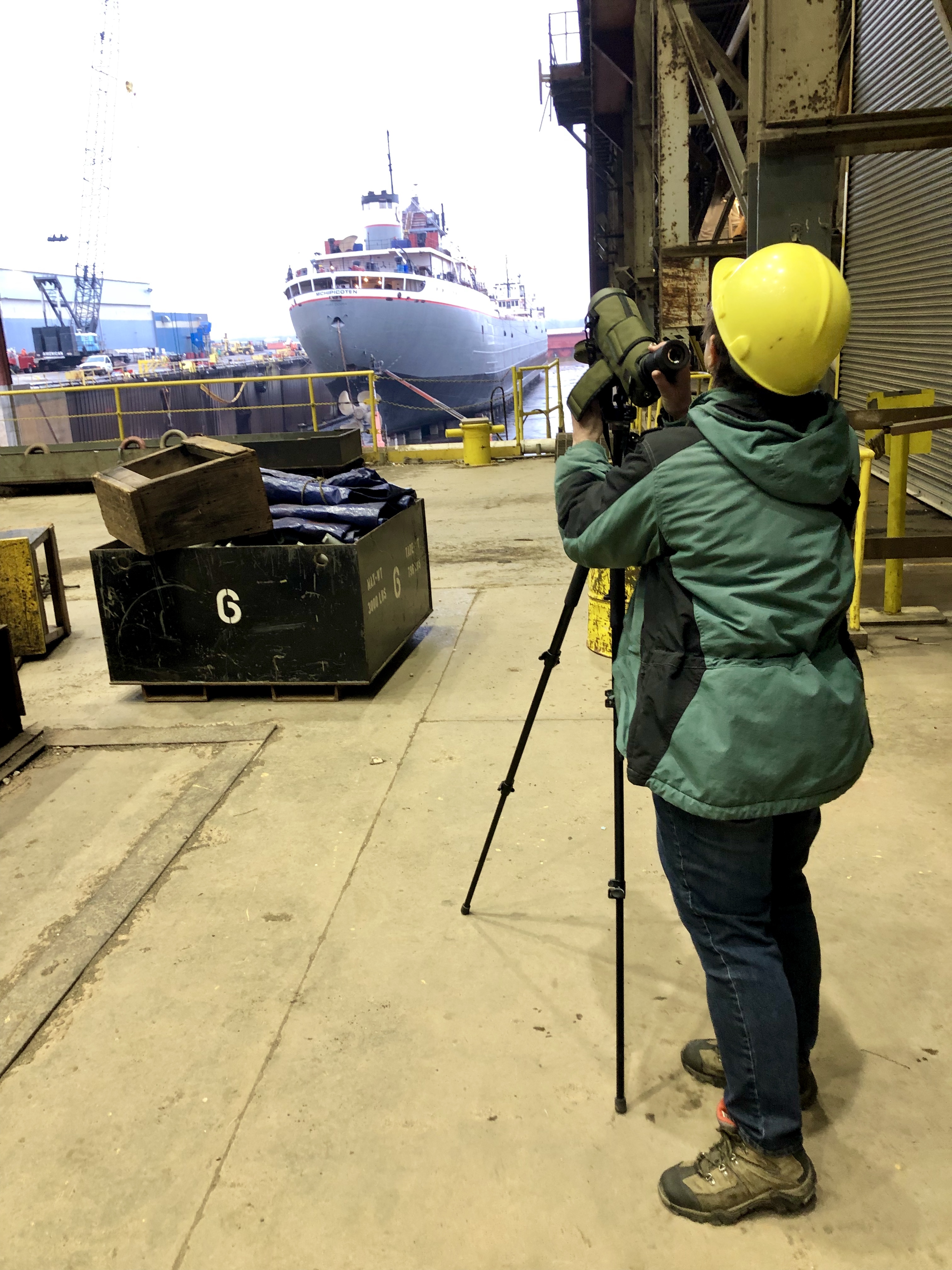
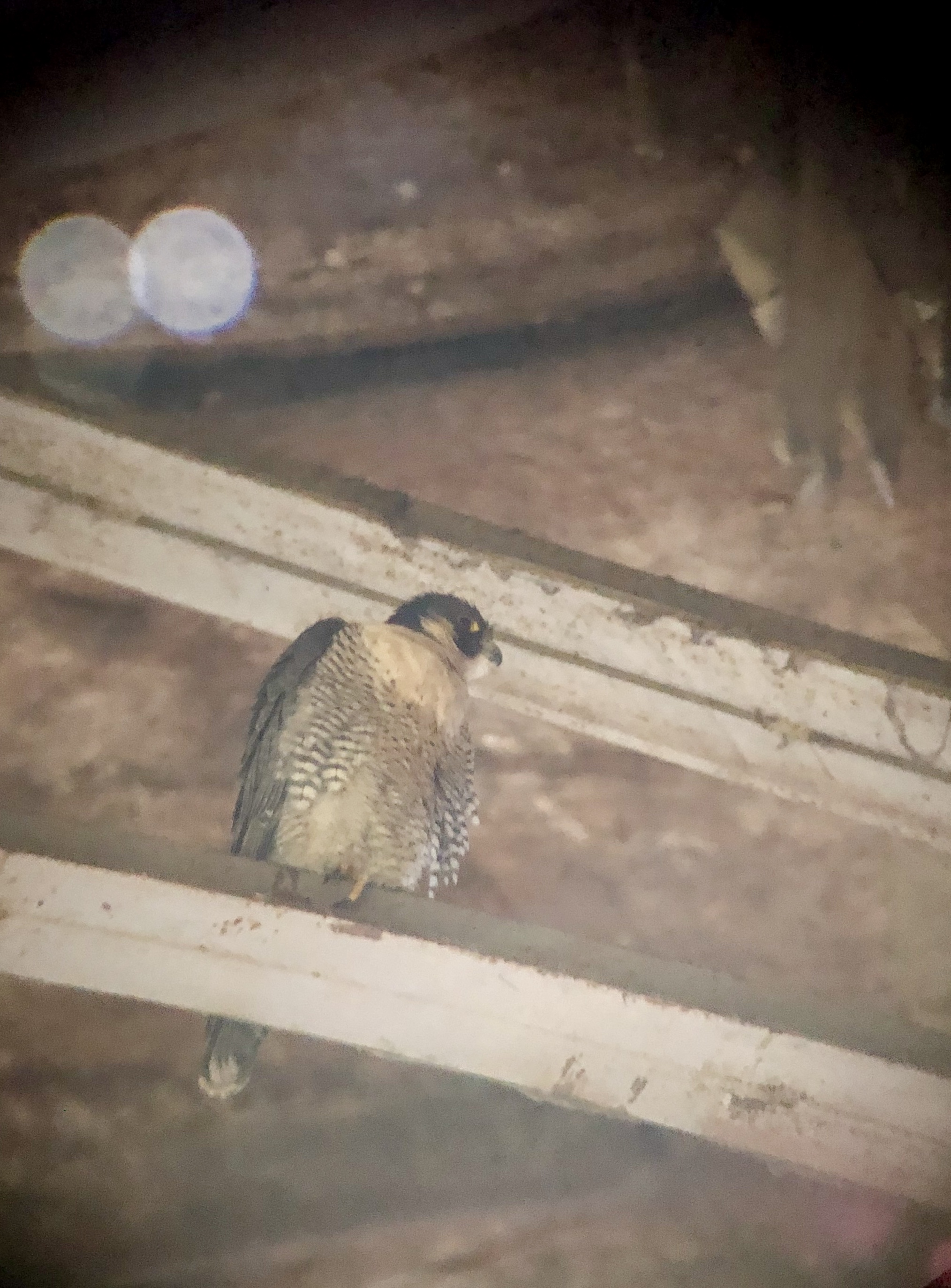
Getting the scope on the female, trying to see if she has leg bands.
The female up in the roof rafters.

Right away when we got into the big bay, we were told that a bird was perched up high. Sure enough, we found the female way up in the roof rafters. She stayed on the same rafter the entire time of our visit in fact. It looked to me like her crop was full, so presumably she had just had a nice meal of … ? In the past I’ve taken lots of pictures of heads, wings, legs and feathers of prey items found here, and these birds have wide-ranging tastes.

About 10 minutes later, the male made his first appearance, coming in through the big open door, actually the whole end of the building. In winter this side of the building gets closed down, and depending on the work they are doing, they may close it in spring, even while the falcons are nesting. But it operates like a big garage door, and they don’t close it the entire way to the ground, so the birds still go in an out under the door. Actually, the facility is designed to be able to float a ship in through the door, so the floor is several stories below ground level here.
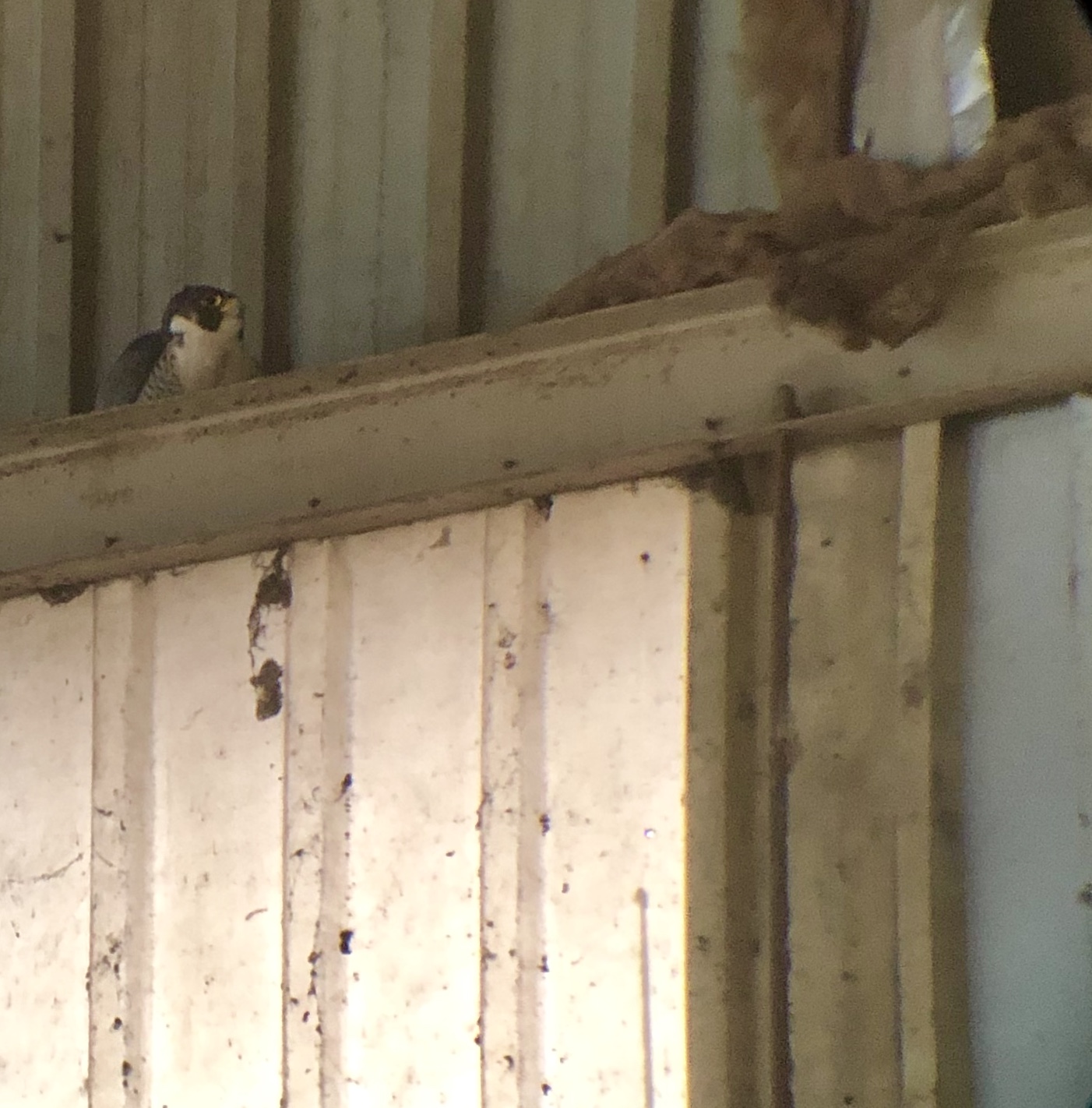

The male, shows the female where he thinks she should lay eggs. A perfect ledge!

The pair called quite a bit, then the male swooped up to the female, and … copulation! A short time later, the male spent quite a bit of time on a particular ledge, just above the “window” line of translucent panels that allow light into the main bay of the building. So probably 80 feet above the floor- perfect height for Peregrines!
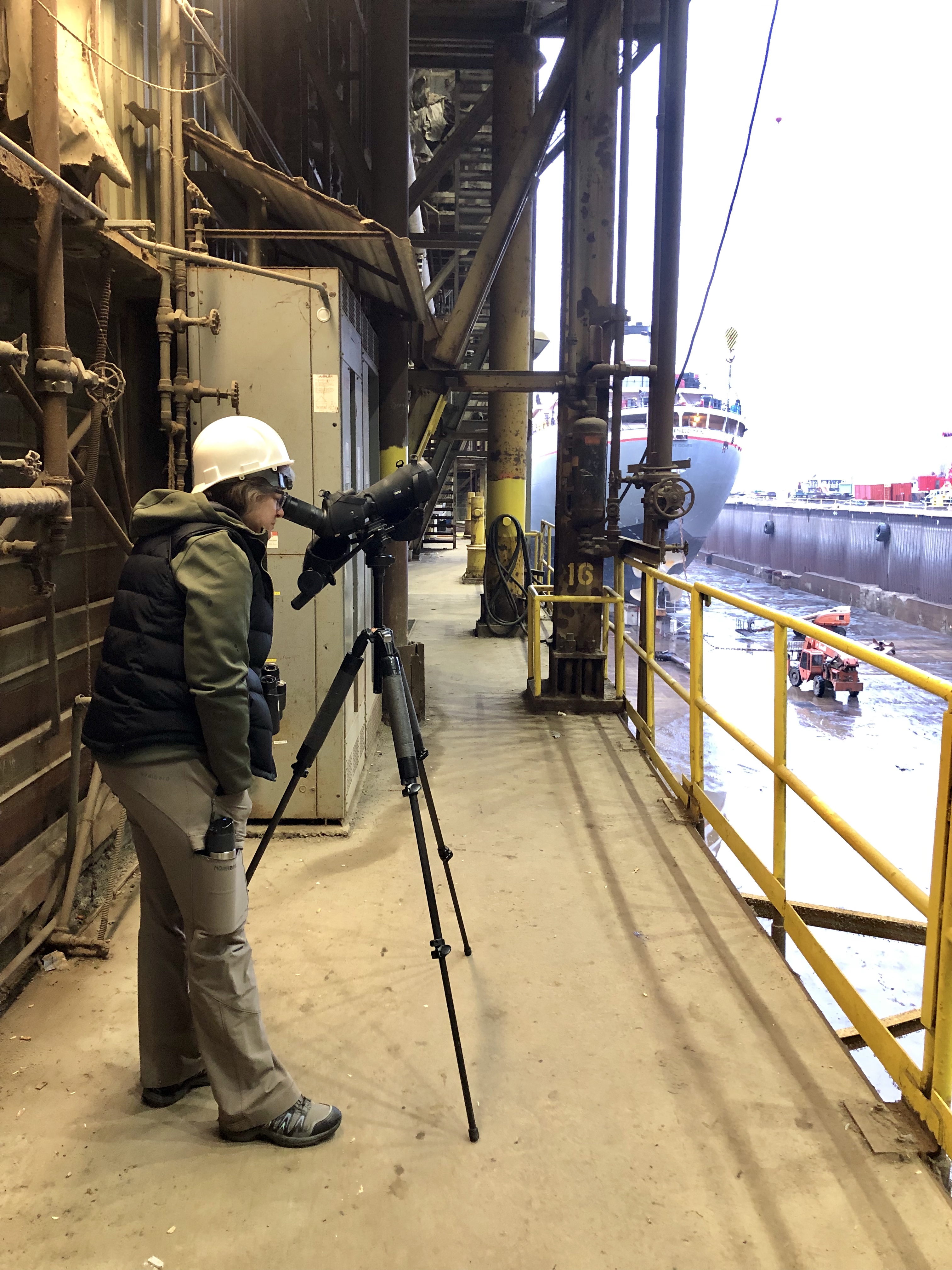
Mary watching the male.

The female watched the male intently, but never left her perch. The male called and watched her. About 17 minutes after the first one, the male flew up to the female and they copulated again. Again he returned to the same ledge, but she never joined him.

We struggled to see their legs because we were hoping these birds were banded and we would be able to tell if they were the same pair as in previous years or not. We never were able to see the legs of the female, because she was so high in the roof and the truss she was perching on obscured her legs from our lowly vantage point. Fortunately the male eventually moved to the outdoor crane and perched in a way that we got a good look at both legs. No bands. The previous male here was banded. What has become of him? And where is this male from? Could he be an offspring of the old breeders from a previous year who has taken over his natal site? We don’t know.
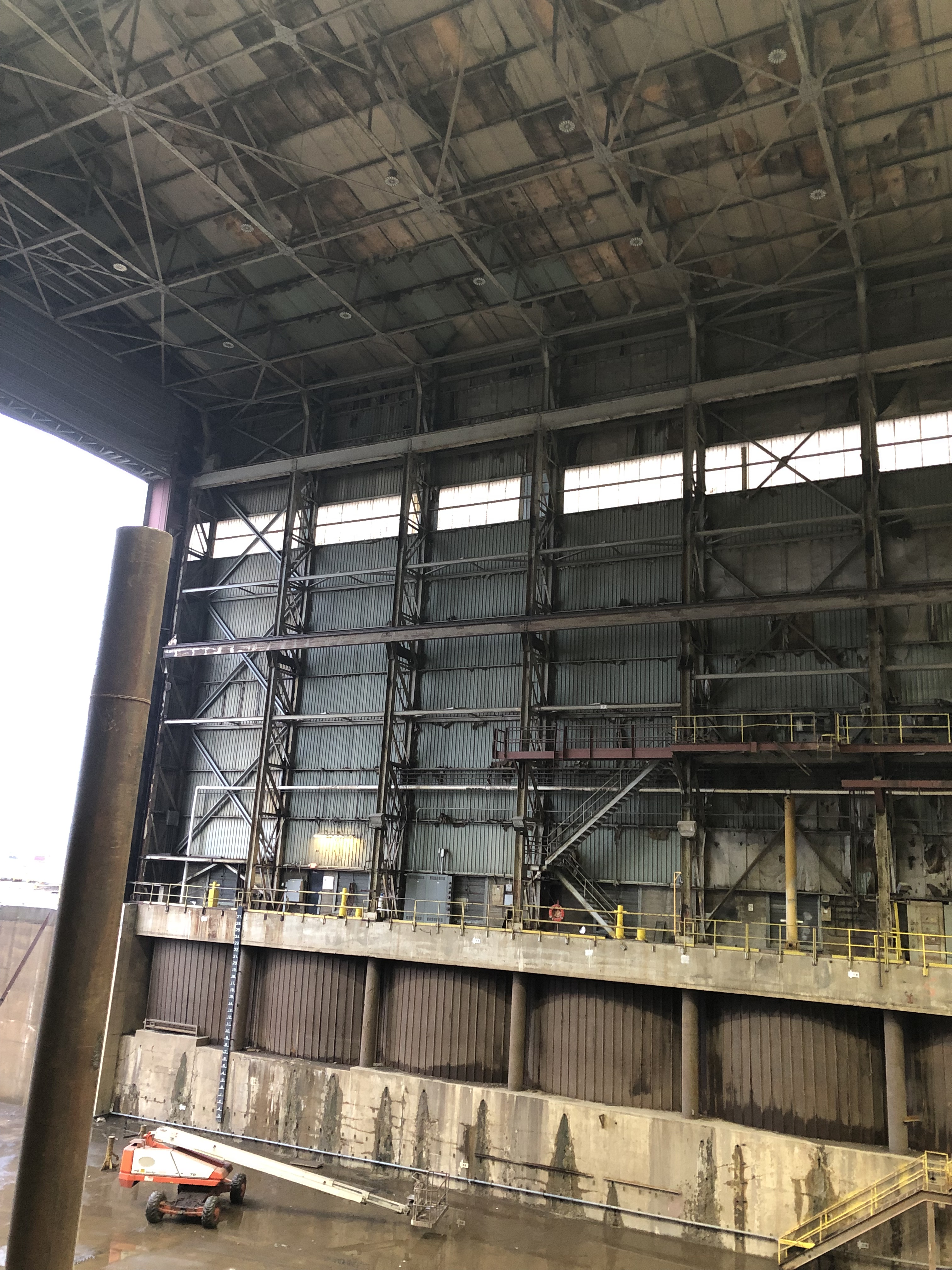
Peregrine nesting habitat? Yes!

We had a successful visit, and will return again in a few weeks. We hope that the male is able to convince the female that the ledge he selected is just right for their brood. Unlike the scrape site chosen in previous years, this one was relatively easy to relocate and observe. It’s amazing how many ledges and crevices there are inside a structure like this one, and there have been some years that we never did figure out exactly where the pair had their scrape.

Again we were amazed at the birds’ choice to use this site. The whole time we were there, shipbuilding was happening, with loud machinery, sirens going off whenever the roof crane moved, sparks from welders flickering, constant clanking, buzzing, pounding, you name it. None of it seemed to bother them. They observed the human activity from high above. Perhaps it keeps them entertained? Mary noticed that the gulls were teasing the falcons, flying daringly close to the big door, letting a wingtip cross the invisible fourth wall as they streaked by. Indeed, as the male left to go to perch on the high crane outside he struck at a gull playing this dangerous game. We heard a squawk from the gull as the male flashed by it, and the gull hauled tail out of view.
Categories: Uncategorized | Tags: , , , | 2 Comments

Belize!

What better way to get through February than to go visit some of our summer breeding birds on their wintering grounds?  My husband and I had originally planned to go in December, but we just didn’t get our act together quickly enough to make plans last fall.  To tell you the truth I’m glad we didn’t go then because this winter has been a real doozy, and we needed the break now more than then!

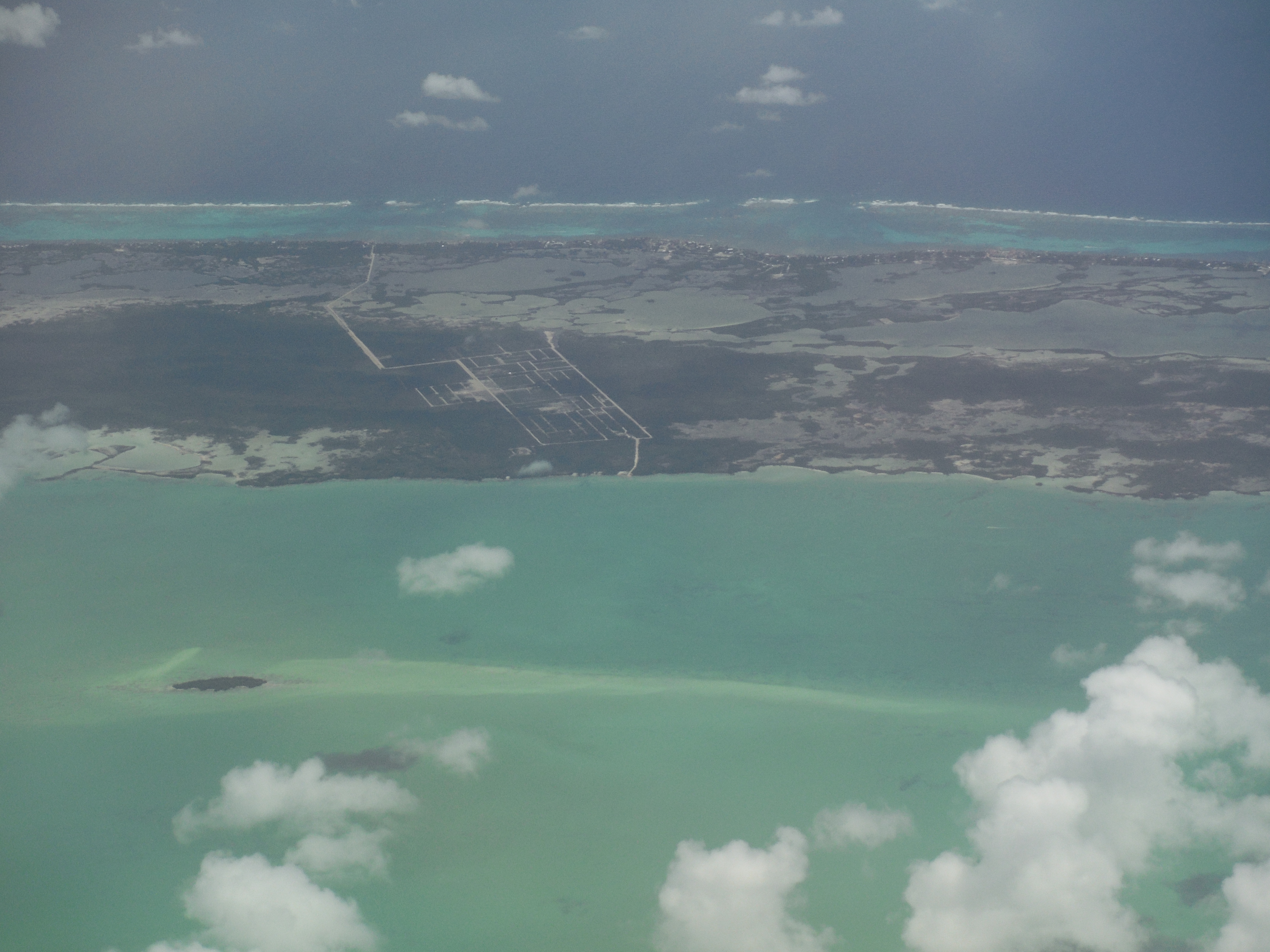
So we left from Pittsburgh early on February 4th, and by noon we were in our rental car, leaving the airport near Belize City.  Flying in, I couldn’t help thinking about what a migrating warbler sees as dawn arrives and it finds itself making landfall with a view something like this.

Image

From the airplane. Is this what migrating birds see?

This was probably taken from a higher altitude than the birds actually travel at, but it was taken during our descent towards the airport.  I was thrilled to see the blue Caribbean water, with the beaches and the mangroves surrounding all the cayes. No doubt the migrating warblers are also thrilled to be arriving here.  What is incredible to me is that the recent fledglings, hatched in Pennsylvania woods just a few months earlier, make this flight on instinct alone, never having been here before. It’s true that they are flocking up with other migrants, and staying in touch with them using flight calls during the night as thy fly south, but it’s still incredible that they all do this, every year.

Neither Ron or I had ever been to Belize before, but we have spent a fair amount of time in Costa Rica. So as soon as we were on the ground we were seeing and hearing some familiar sights and sounds.  Great-tailed grackles are ubiquitous and conspicuous both here and in Costa Rica, for example.  Right away I began my attempts to resurrect my once fairly extensive knowledge of tropical plant identification.  There were loads of trees, roadside weeds, shrubs, etc., that I knew I had once known the name of.  Some of the names came back.  Ceiba!  Yes!  But others…  I could remember interesting factoids about some, but not the names.

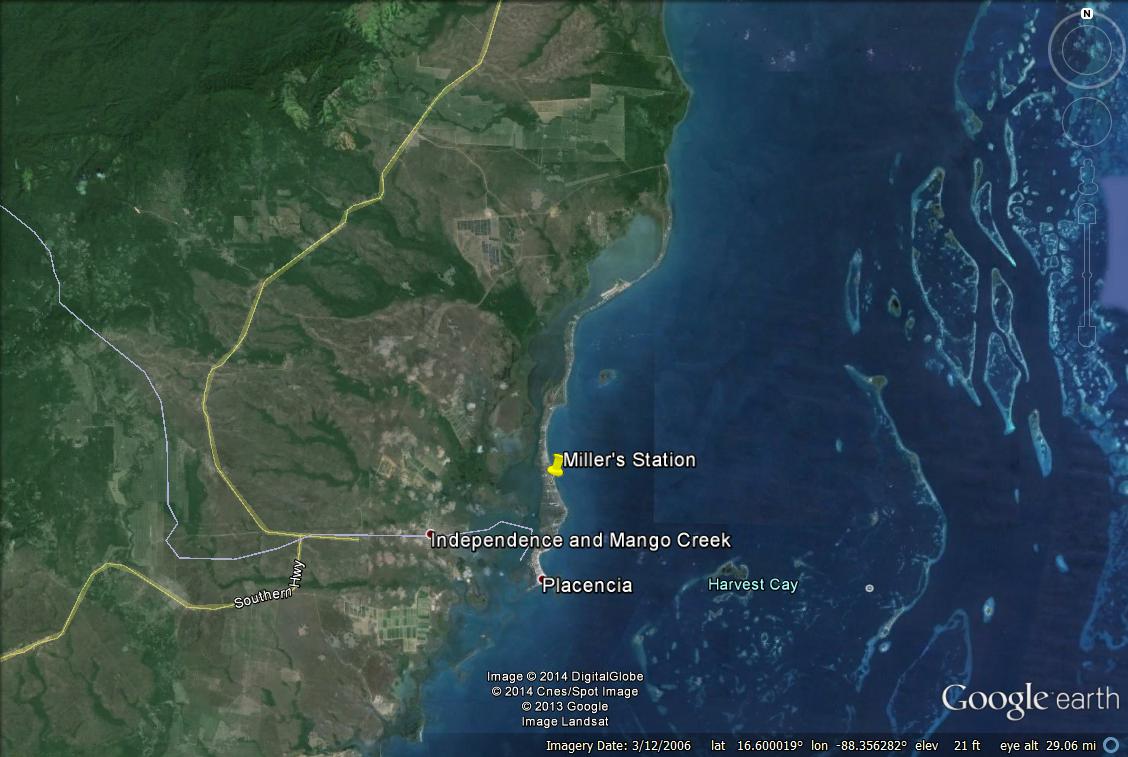
Our first three nights we stayed at MIller’s Station, on the Placencia peninsula.  The idea was to thoroughly thaw out and get in some beach time.  And a few rum drinks. And see some coastal birds.

Image

Stann Creek district of Belize, with the Placencia peninsula.

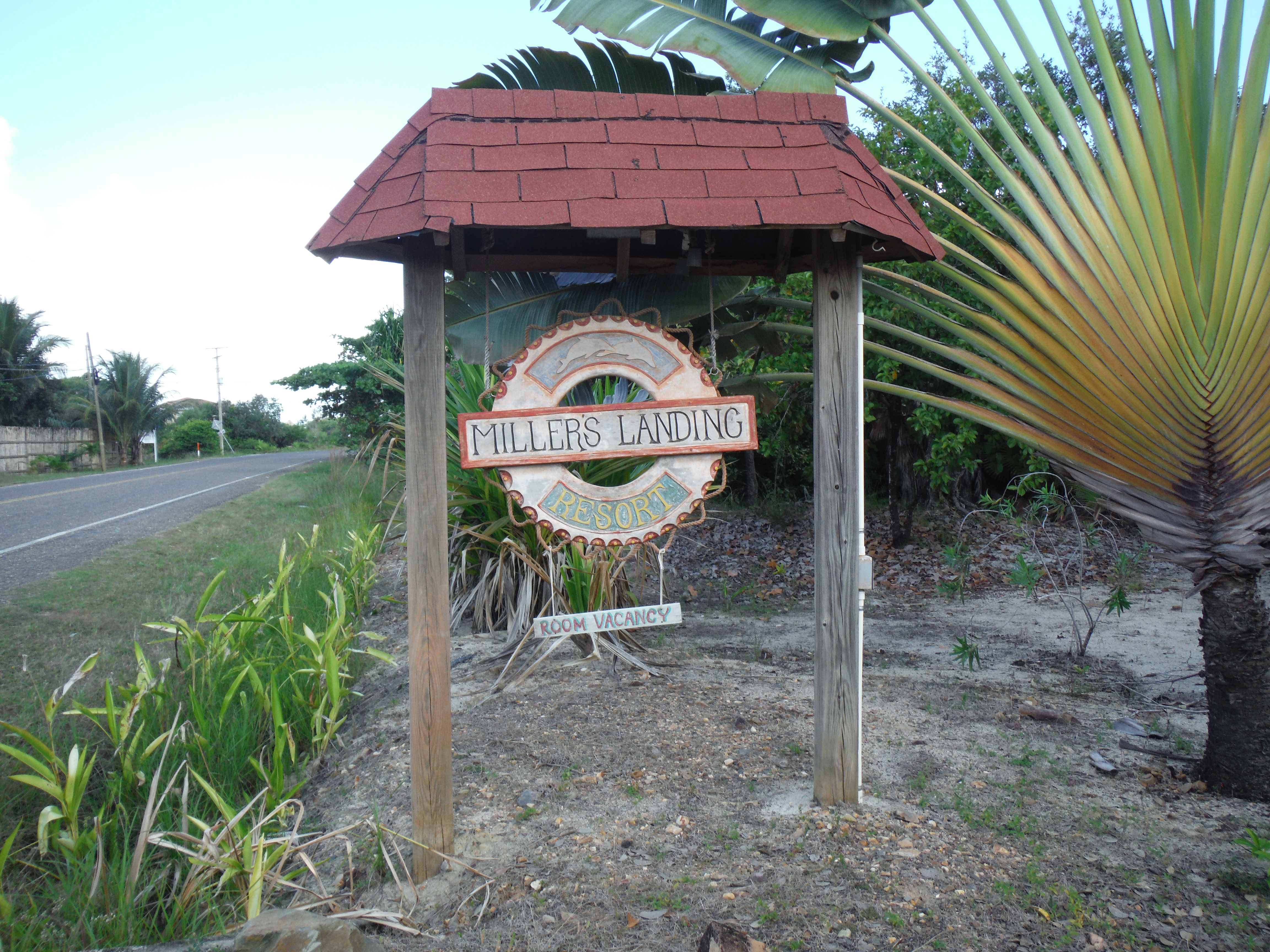
Sign at the entrance to Miller's Station.

Sign at the entrance to Miller’s Station.

The first bird we saw when we got out of the car there was…  a gray catbird! It turned out this site was loaded with wintering migrants. We got about 45 species of birds here total, many of them North American breeding species.  We had lucked into staying at a low key place that had left a lot of the native coastal scrub vegetation in place, which was excellent for birding.  The winding driveway leading in to the hotel had big oak trees (for scrub) that had just had a big acorn year. Much to Ron’s delight, there was a resident family of acorn woodpeckers (one of his former study species) at the end of the driveway.  There were also several wintering hooded warblers (females), his current study species, each with a distinct territory. We walked along the beach, and there was a spotted sandpiper wagging its tail up and down, just like they do along the beaches at Presque Isle in the summertime.  But here there were magnificent frigatebirds and brown pelicans flying overhead.

That’s all for this post-  more on Belize coming soon!  We go kayaking in the mangroves, and I admire thatching techniques.

Categories: Uncategorized | Tags: | 1 Comment

Project SNOWstorm Hits Erie

Image


On Saturday morning I got a call I’d been expecting and hoping for, although I hadn’t known when it would come. Suddenly all my amorphous plans were out the window and I knew how I was going to be spending the rest of the weekend.  Project SNOWstorm (see    http://www.projectsnowstorm.org/) aka Cellular Tracking aka Mike Lanzone, Andy McGann and team were planning to come to Erie, and they needed to get their hands on Snowy Owls.  I had assured them that we have owls, no problem, any time they need an owl, just come up to Presque Isle State Park, and with the help of the local birders who spend lots of time finding all kinds of cool birds at the park I would make sure they got owls.  The team obtained the necessary permits and were planning to make use of the large owl supply we have here.  And now they were on the way here, after their plan for working at the Pittsburgh Airport fell through for this weekend. I felt responsible for ensuring they got an owl or two or three here in northwest PA.  So I started finding owls.

Finding Owls

My first call after the initial call with the transmitter team was to Jason Fidorra, intermittent Audubon PA staff with me, who lives in Erie and who is more plugged in to the birders of Erie than I am.  As it happened, when I called him, he was actually standing on the observation tower on Gull Point (the tip of Presque Isle), looking at a Snowy Owl through his binoculars. Wonderful news-  a confirmed owl! This turned out to be the only owl seen all weekend on the peninsula, and it was in the least accessible location possible- the far sand spit out from the tower. I continued to make more calls to potential informers and to coordinate with the transmitter team.  It turned out they wouldn’t arrive until after 3 PM, so I had time to try to track down more owls.  In talking to others, I found that no one was seeing owls at Presque Isle (other than Jason). We needed more than that!  I started thinking about reports from places off the park.  The airport.  Where else?  Mary Birdsong thought of the one seen frequently at the Fairview Business Park.  Okay my plan was to check those places on my way up to Presque Isle, then scope out the park myself.  I started with Fairview, and right away I found an owl, sitting conspicuously on a rooftop in plain view.  Check!  I went to the airport.  After meeting up with Susan Smith who has been keeping an eye on owls there, I found one owl hunched down on the ground in between the runways looking like a slightly dirty snowball.  Check! I went to the park.  Drove around. Searched high and low (but didn’t hike out to the point- too late in the day). No owls at the park.  

Catching Owls

Once the team arrived late on Saturday afternoon, they went straight to the Fairview Business Park and staked out the owl on the roof there.  These are some of the most experience raptor trappers in eastern North America, so I was confident they would get this owl, then have all day Sunday for more!  I was torn about leaving, but I had a prior commitment so I went off to my other event, thinking I would soon be hearing about their success. To my surprise, I learned via text and emails during the evening, the owl ignored their best efforts to lure it into their trap, so they called it a day at about 9 PM.

First thing in the morning on Sunday, the team plus many of their friends and followers combed the park for snowies.  No owls at the park.  So, they tried the airport.  The airport didn’t have enough staff to send someone out with them to trap within the restricted area, and the owl that was visible there was again hunched down, on the ground, not actively hunting.  Not likely to be responsive to a trap. So, back to Fairview.  All day long, with many comings and goings of friends, acquaintances, weekend visitors from Pittsburgh and beyond, the team tried to interest this owl in the trap.  The pigeon was of zero interest to it. A rat was tried.  No interest. Meanwhile it was catching voles and scarfing them down.  Mice were tried.  No interest.  It casually watched the people watching it.  It seemed amused. In fact it was basically thumbing its nose at all of us. It was easy to imagine it laughing.

Meanwhile, I felt responsible for providing owls, so I tried to find more owls.  I went out to Erie Bluffs, thinking the permits are in place, so why not try?  Unfortunately the corn there was never harvested so the habitat wasn’t good for the owls.  I hiked in to the dune restoration area, but no luck there. I had already contacted my Crawford County informants, trying find out if anyone had an owl there. No is the answer.  I’m sure there are owls in the countryside in Erie County, but the problem is, all the birders just go to Presque Isle when they want to see a snowy, so no one is really out looking in the countryside. I end up driving a very circuitous route back to Meadville through many snow drifted back roads in Erie and Crawford counties, scanning all the fence posts and telephone poles for owls. Back in Fairview, by mid-afternoon, hopes are dimming, and there is talk of retreat, defeat, waving the white flag, giving up. This owl is not destined to become a star for Project SNOWstorm. Slowly all the onlookers and visitors head home.  The core of the team, MIke and Trish plus Owlman Tom McDonald from Rochester decide to check back on the airport owl. Others will look along the interstate on the way south. 

I made it home and was glumly watching the Patriots go down, feeling like I had failed in my responsibility to provide owls.  A little before 6 PM, I got a call from Mike.  THEY CAUGHT AN OWL!  Hallelujah!  Success!!! They caught it by the airport, but wanted to take it indoors to work on because they were teaching Tom how to attach transmitters. Could I get them into the TREC?  Yes, I can. About 3 minutes later I was driving north, back to Erie. Just after I got on I-79, I got another call from Mike.  He was laughing.  THEY CAUGHT A SECOND OWL!  Apparently the two had been interacting with each other, chasing or trying to establish hunting rights somehow, and it followed in the first one’s footsteps (wingflaps?) into the trap.

Processing Owls

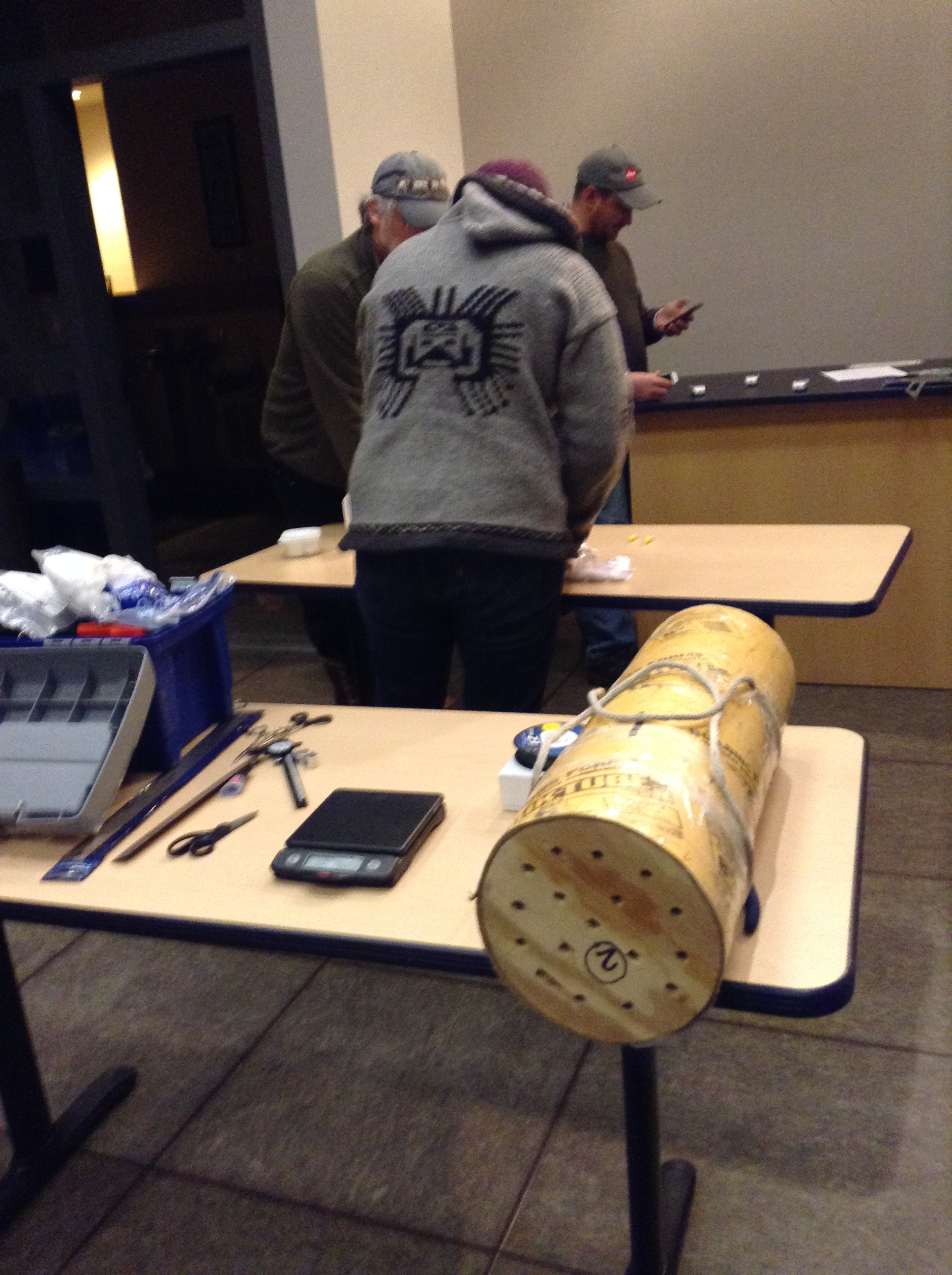
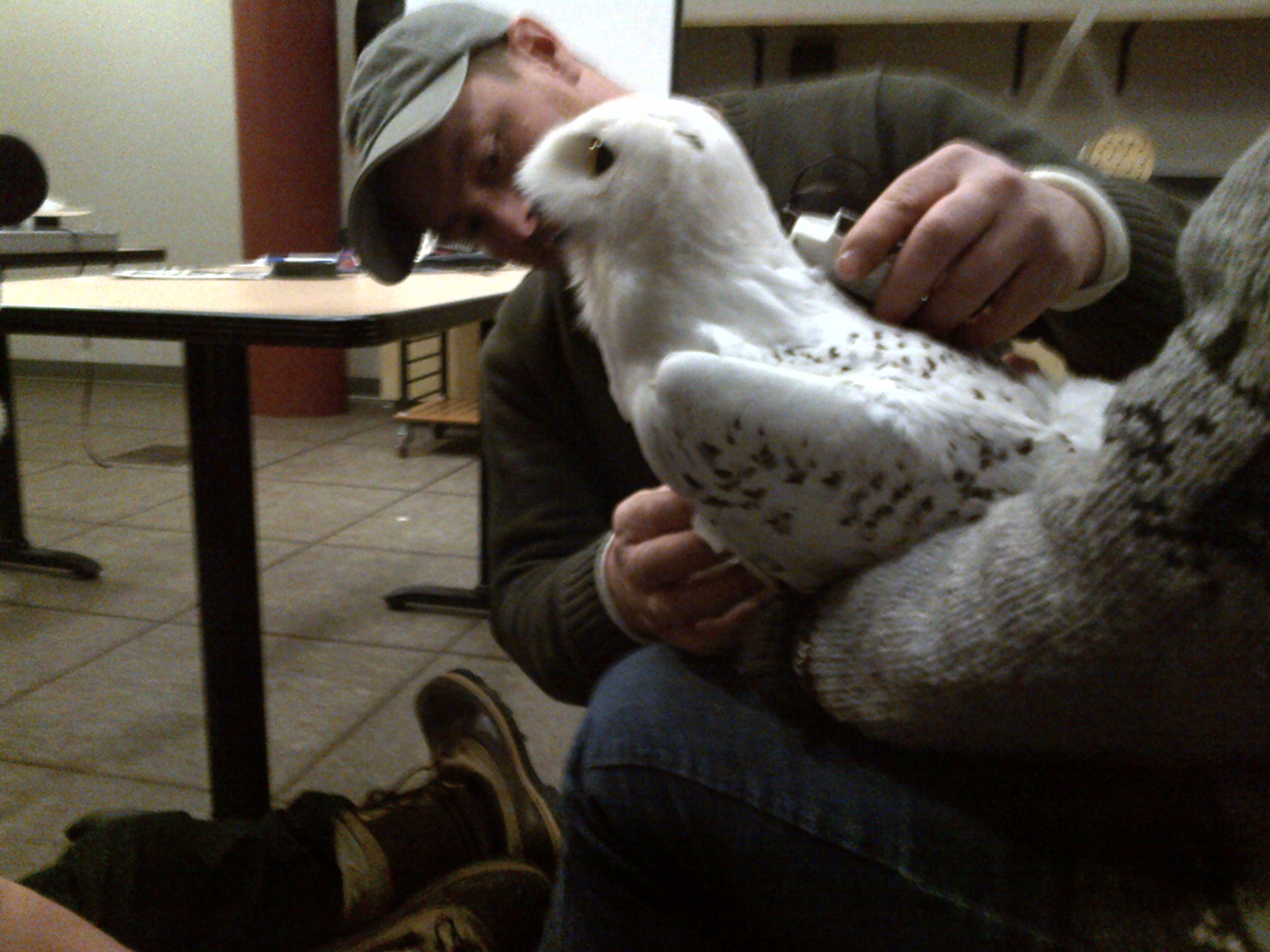
We set up in one of the classrooms at the TREC. The owls were in big tubes that Tom uses specifically for holding owls after trapping. Image

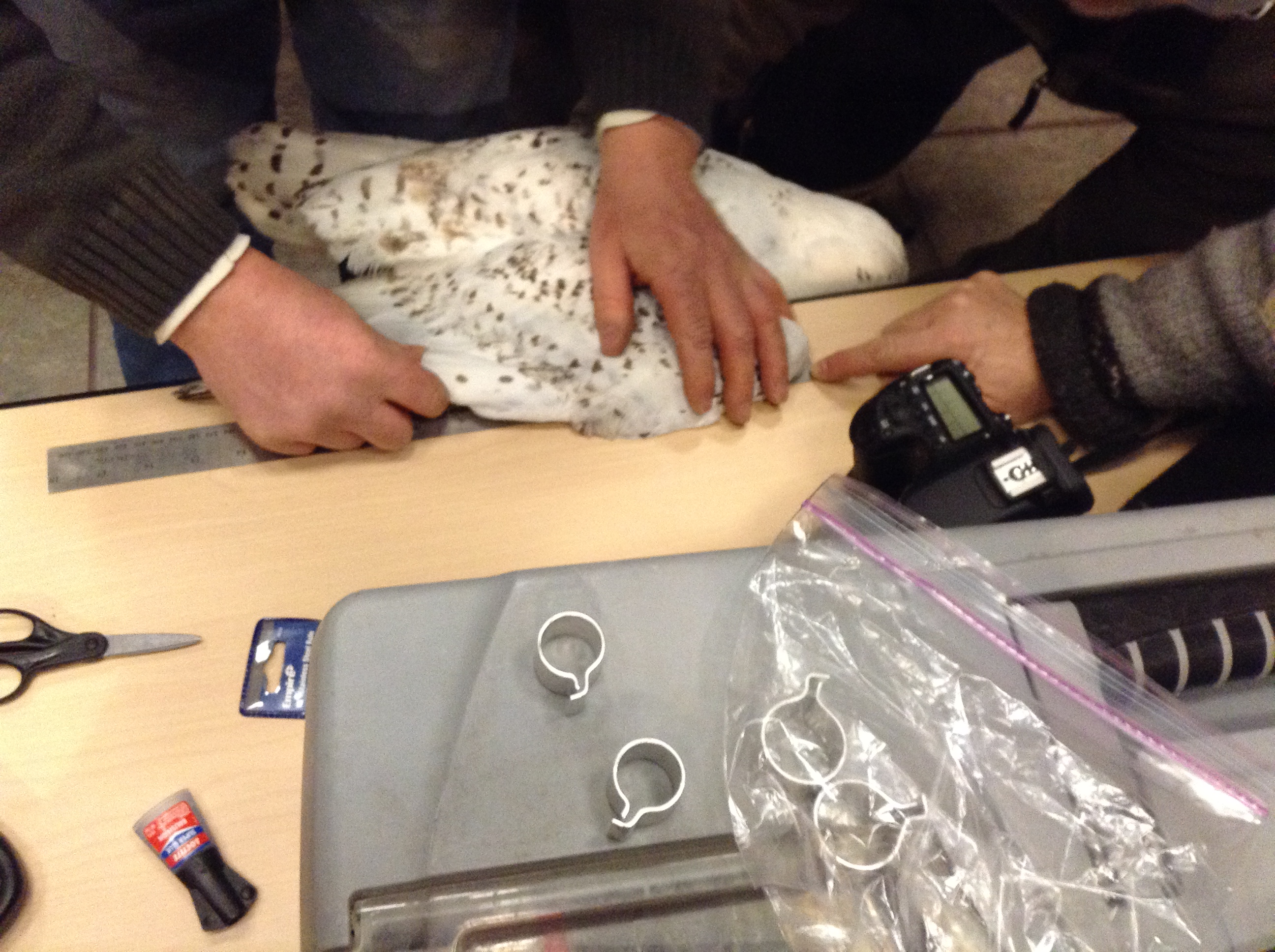
 First step:  weigh the owl in the tube.  Once extracted, the empty tube is weighed and the owl’s weigh is calculated.

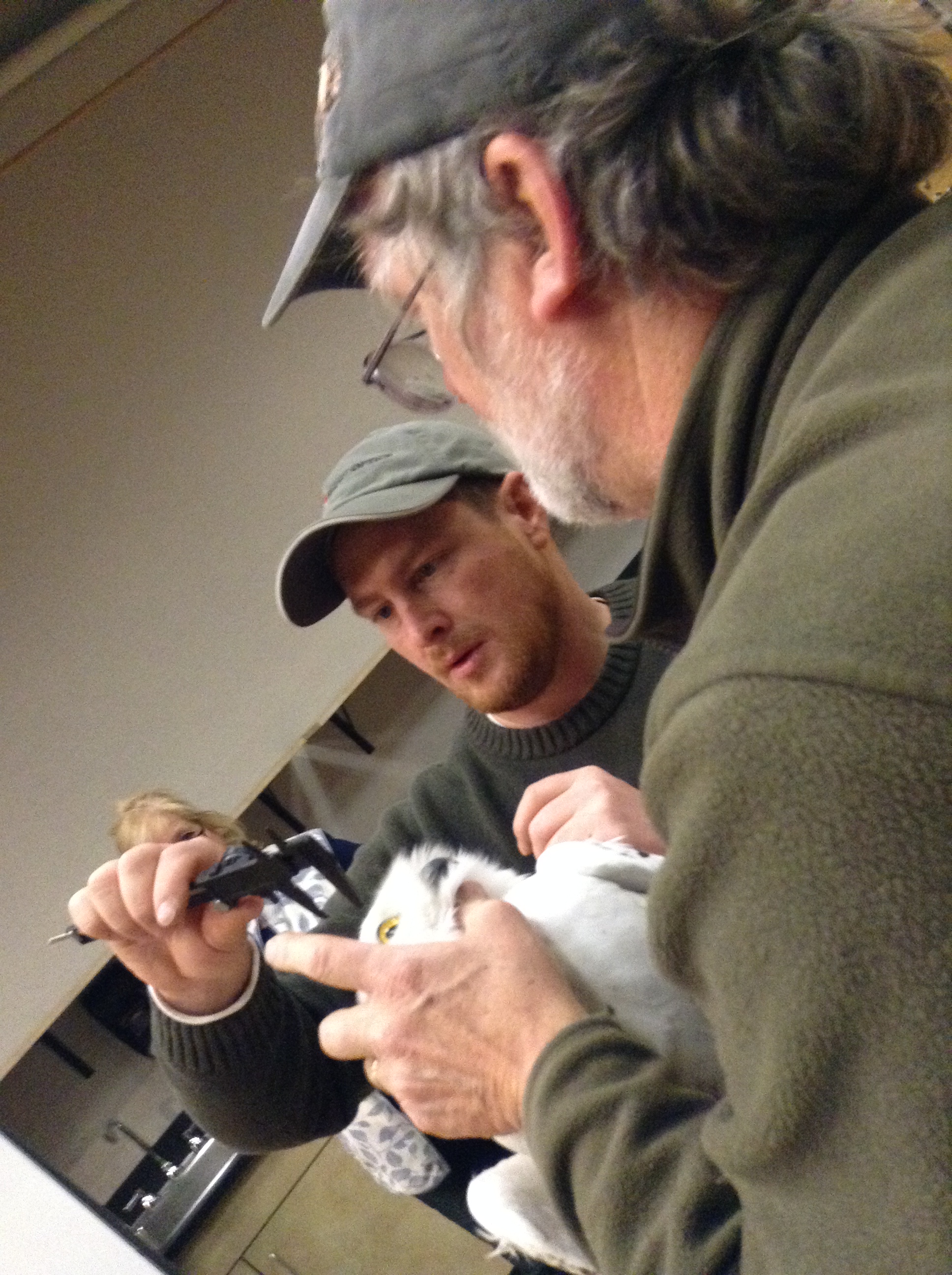
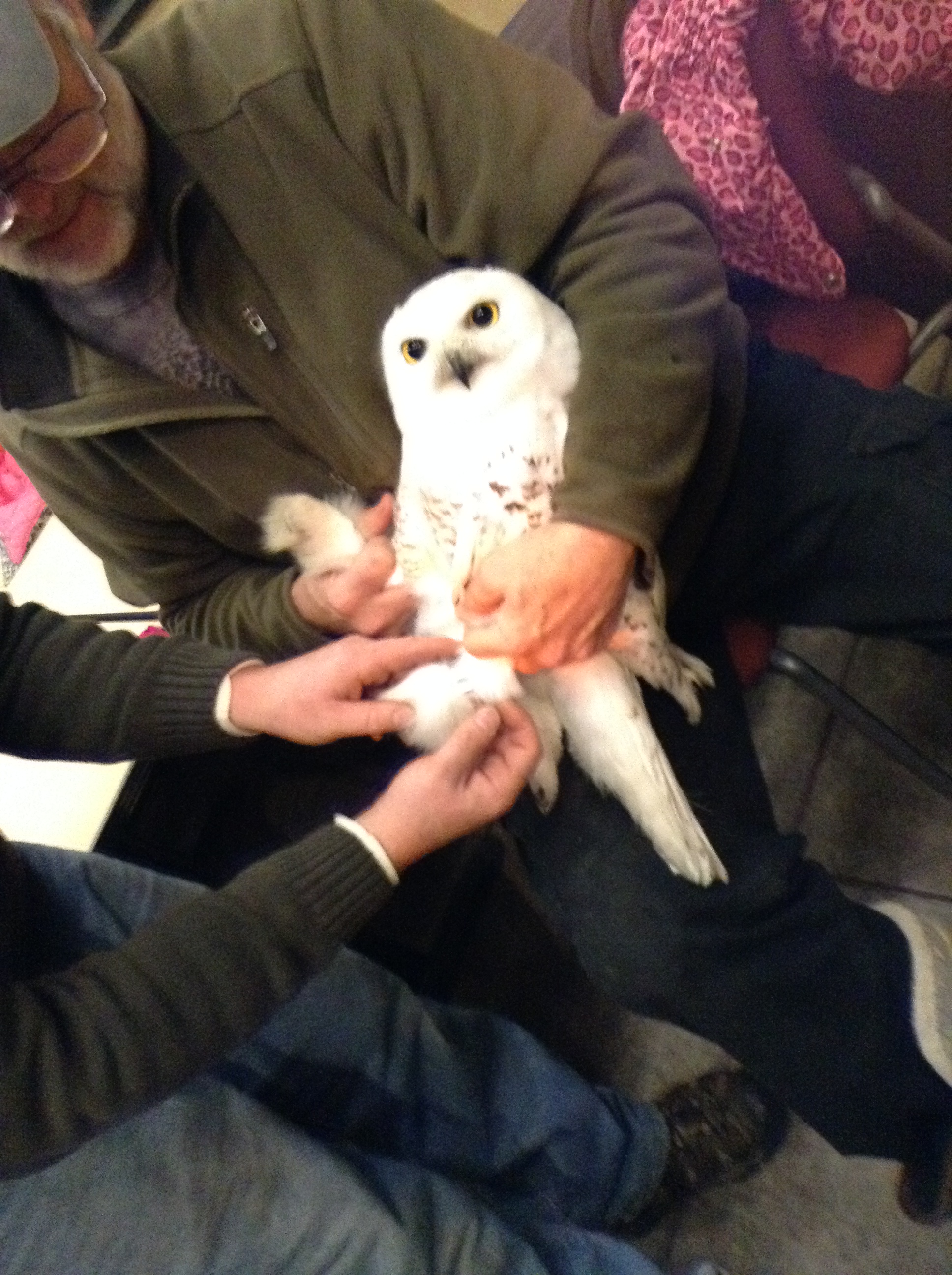
Next step: measure the owl’s tail length before taking him completely out of the tube. After that, finally, pull the owl the rest of the way out and take a good look at him!  Many oohs and aahs! We look at his markings and discuss his age and sex.  Male, either six months old (Second Year) or 18 months old (Third Year), based on a (possibly) replaced seventh primary. I don’t recall which was settled on in the end.

Image

More measurements come next: wing, skull, hallux talon, bill length, width. It turns out this owl is very heavy for his size (like Mickey Rooney, says Tom, Short but heavy!). He has been eating well lately.

Image

Image

He gets a band on his left leg.

Image


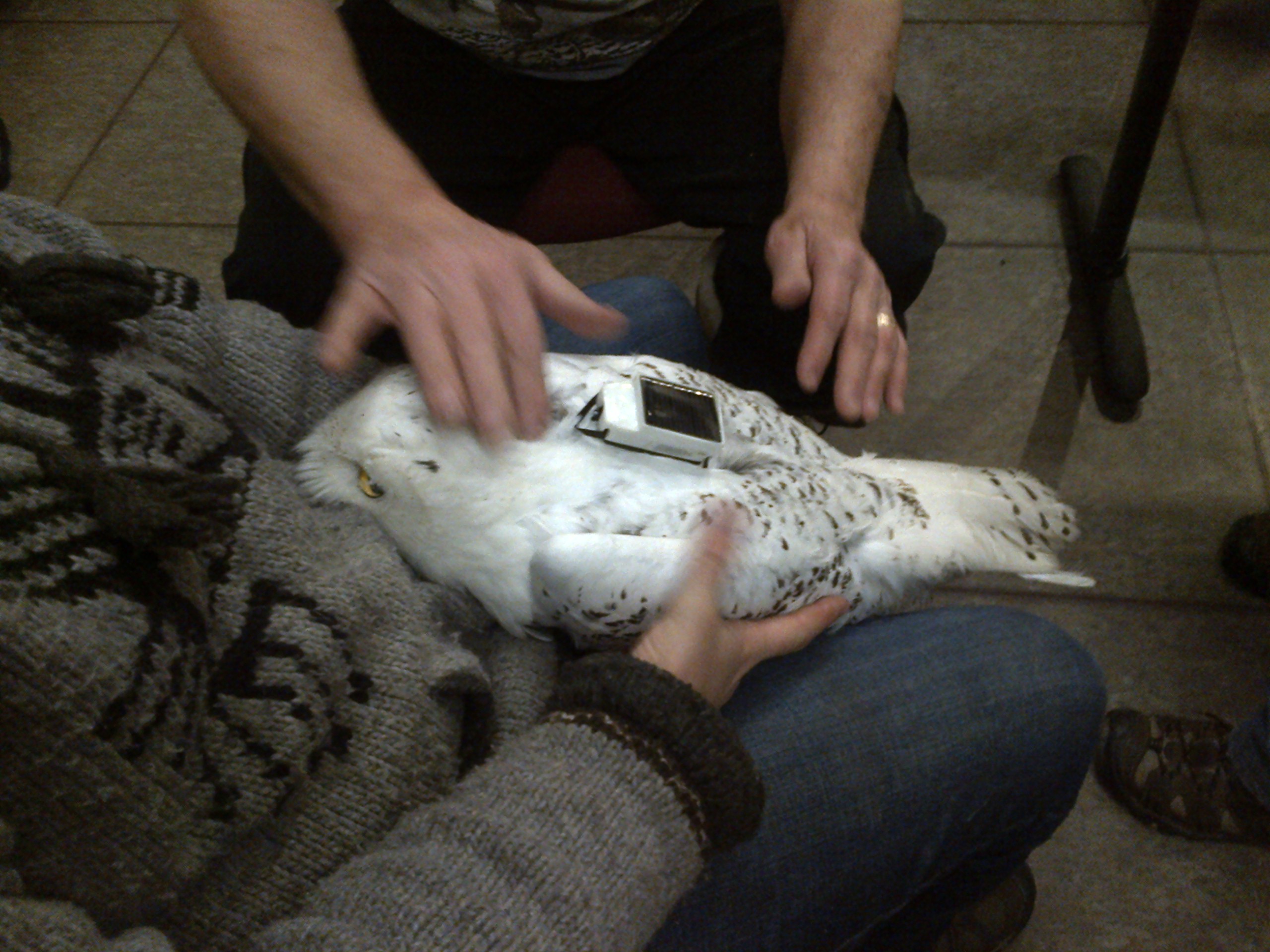
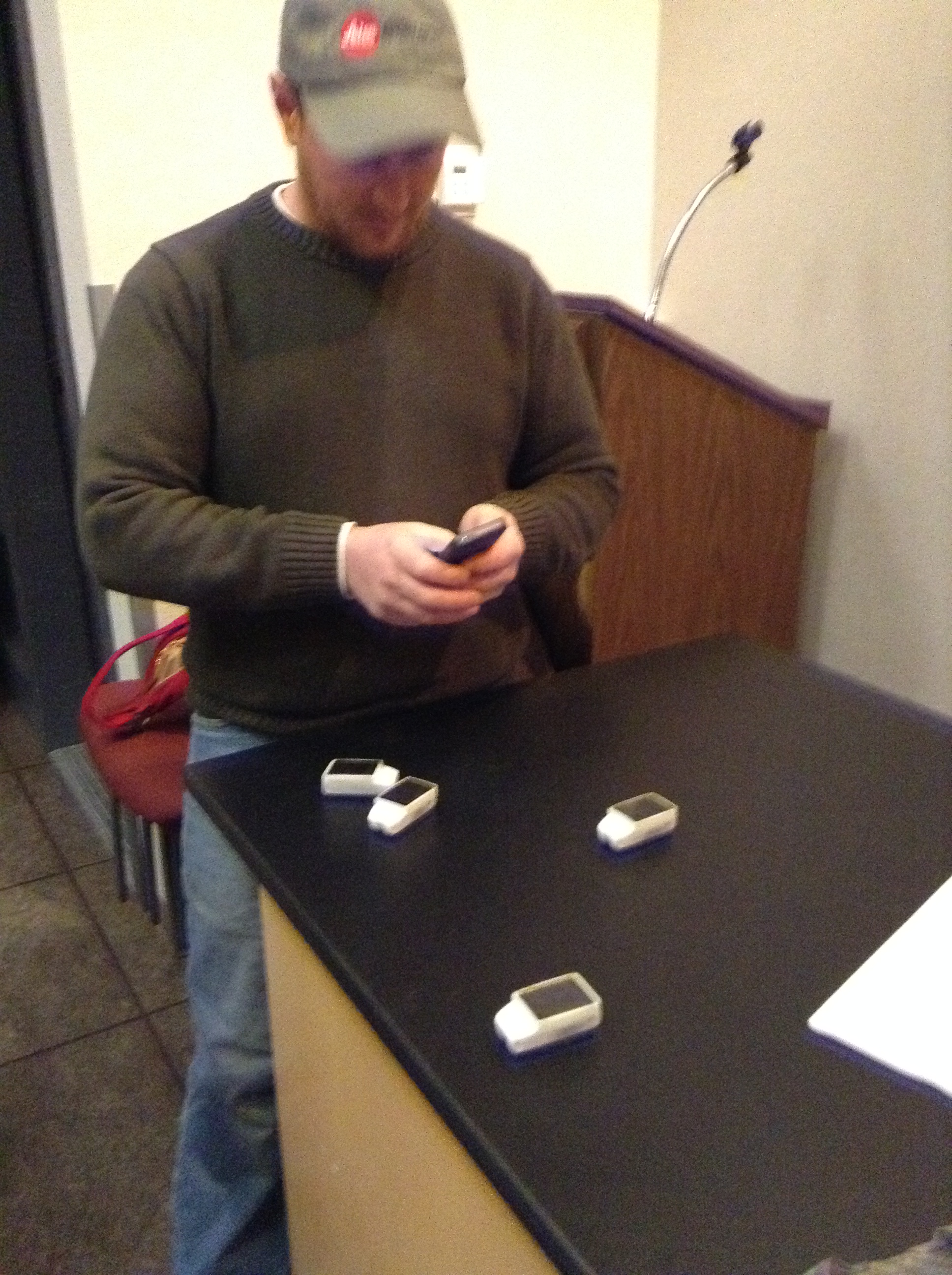
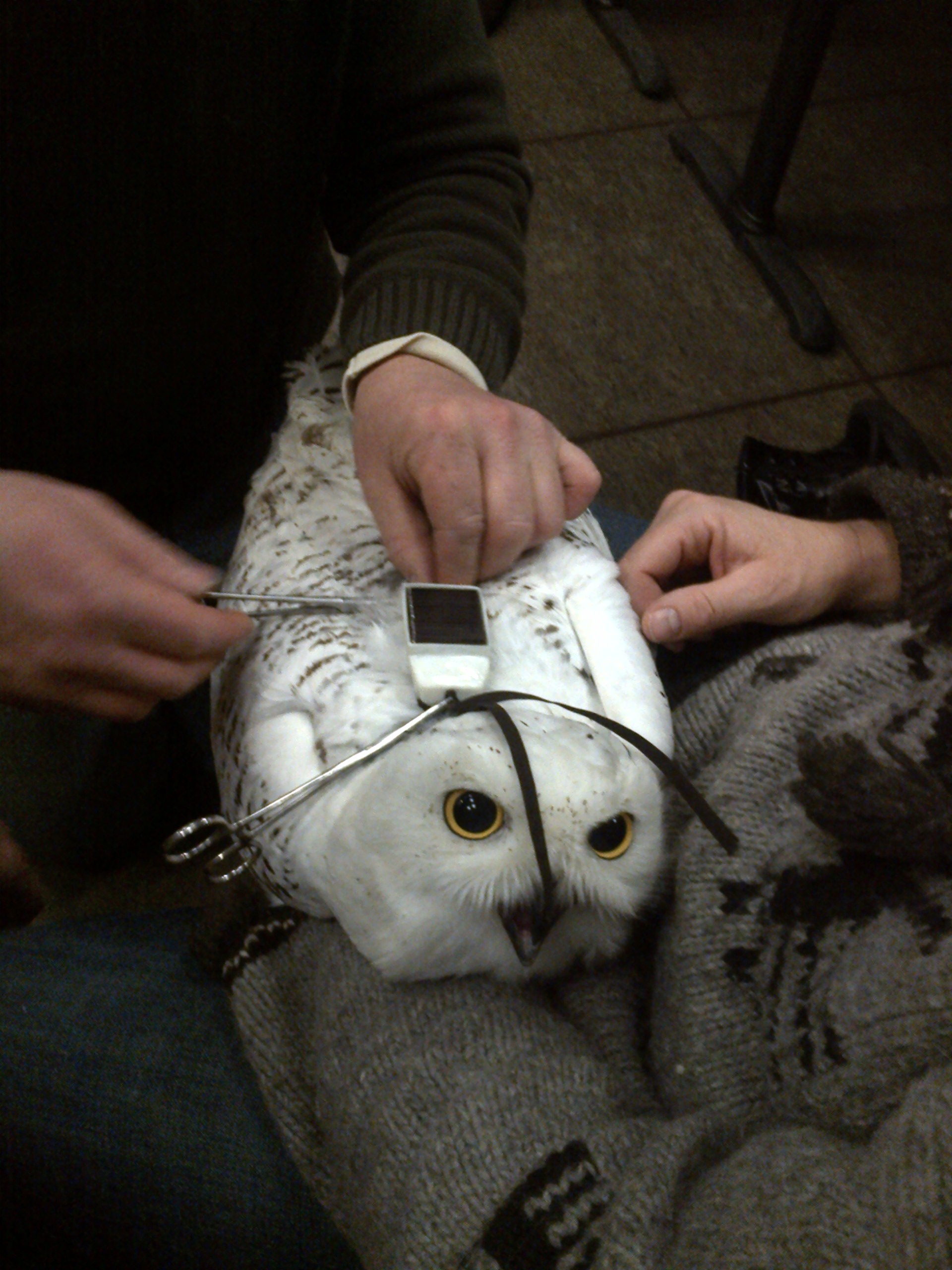
Then the transmitter outfitting starts.  This is a long process.  The fit of the harness is incredibly important. The owl lives with this the rest of his life. It essentially becomes part of his body. Mike picks out a transmitter first, checking the battery levels of all the ones he has on hand. 

Image


Then the harness fitting starts.  Woven teflon (flattened tubular strip about a quarter inch wide) is the main material.  It is sewn together around the owl, then the strips are worked under the feathers so they fall between feather tracts on the owl’s body. It can’t be too loose or too tight. 

Image


Image


Finally, the transmitter is adjusted to the satisfaction of Mike and Trish. The ends of a few feathers are clipped from just above the transmitter to minimize possible shading of the solar panel.  These are kept for isotope analysis. 


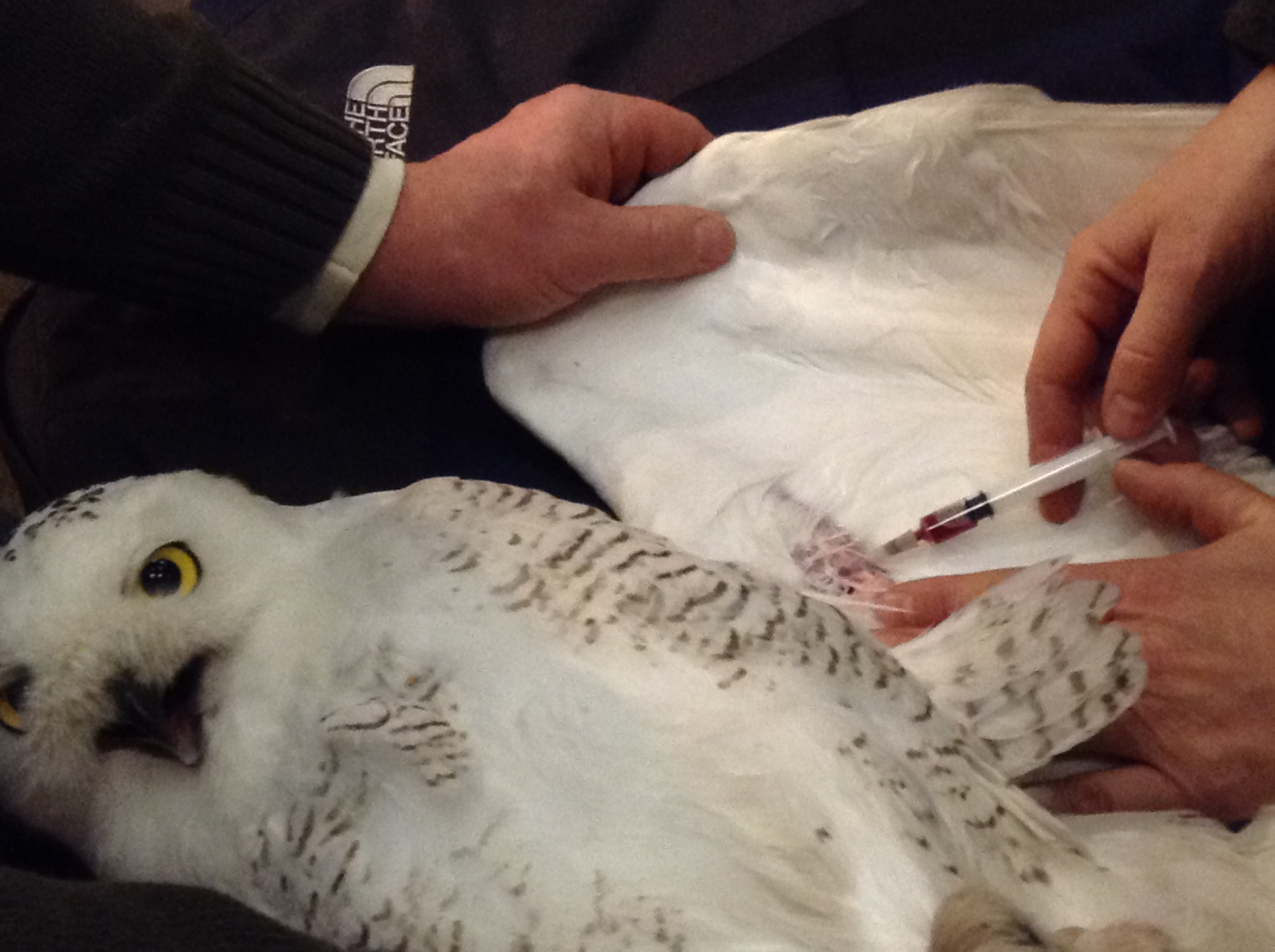
The last thing is to draw a blood sample. Several tests are run on each owl, for genetics, exposure to heavy metals and pesticides, etc.

Image


Trish is such an expert at this that not a single drop of blood ends up anywhere other than in the sample. Finally, Erie-1 is done!  He has been a trooper the whole time and now gets to go back in his tube, and we put it next to an open window so he can cool down. We have opened the windows to make it cooler, but it is still warmer than these guys are used to.

We repeat the whole process with the second owl.  This time, Tom makes the harness and attaches it, since this is his training session. How lucky for us that we had a second owl for him to try his hand on, while still under the watchful eyes of Mike and Trish. This owl (Erie-2) is another young male, and is also quite heavy for his size.  In fact he has bulging fat in his armpits, one of the places that owls store fat. Unlike the first one, who was very mellow and relaxed the whole time, Erie-2 is a bit hyped up and tries to bite at every opportunity. We end up fashioning a makeshift “hood” out of a bandanna that I have in my bag to keep him calmer.

I won’t prolong this post any more.  We finished all this pretty late at night. It was time to let them go.

Releasing owls

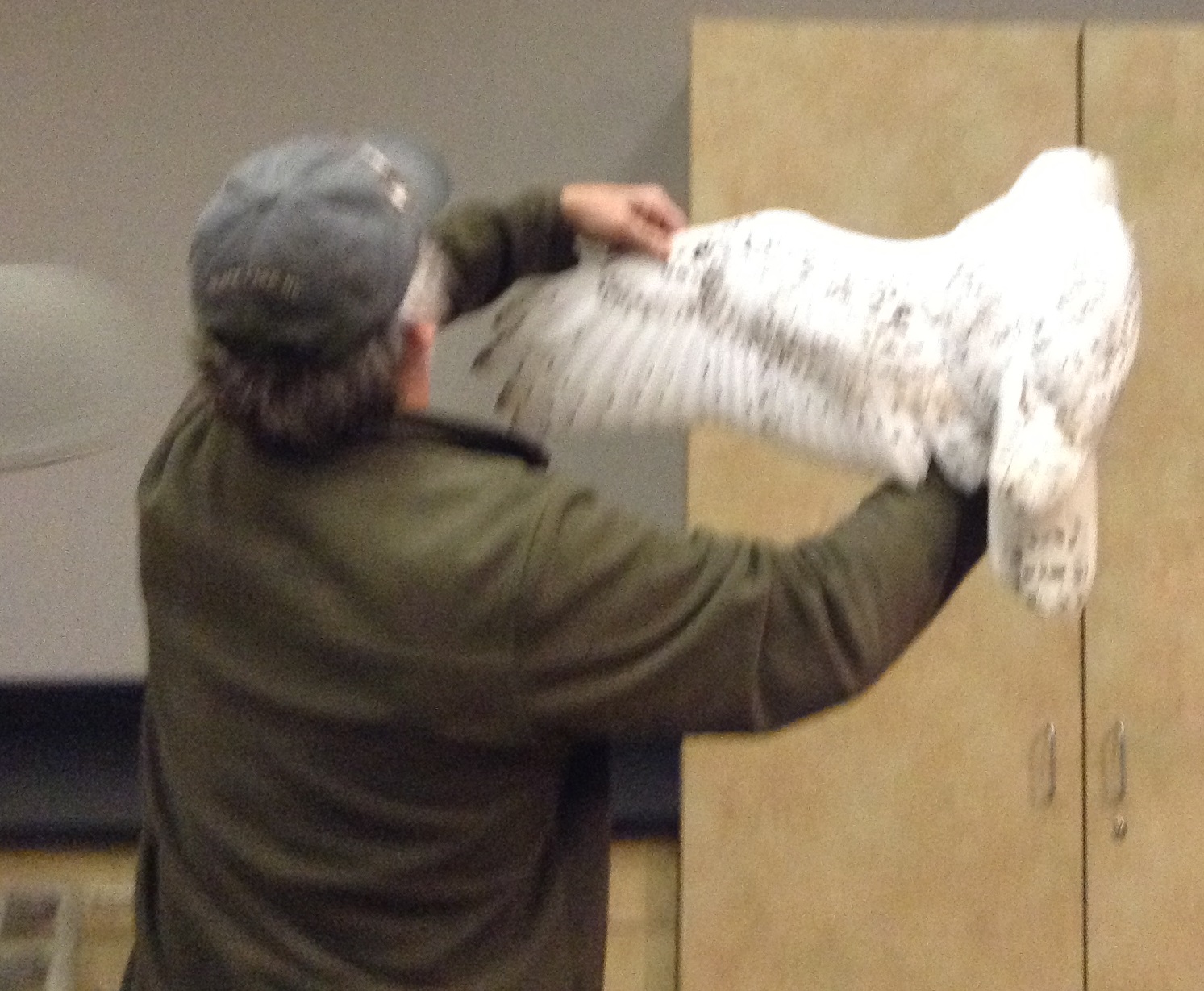
We debated where to release them.  Normal practice is to take them right back to where you got them.  In this case, though, we really didn’t want them to be exposed to the risks at the airport.  So we decide on releasing them at the park.  We knew they are quite capable of making their way back to the airport on their own (like Philly, another owl with a transmitter), but wanted that to be their decision, not ours. We decide on the “ballfield” at Presque Isle, just past the Ranger Station.  From there they can continue out onto the peninsula, or they can return towards the airport if they prefer. We released them one at a time, a little before midnight. Each one got a snack before going. Our way of saying thank you and to make up for lost foraging time,  Each one was alert and aware and eager to go.  Owlman Tom gave them each a nice boost into the air and they flew strongly across the field off over the bay.  And each one veered right, back towards the airport, once over the water. 

Success!  Now we just have to be patient and wait for their transmitters to download every three days.


Categories: Uncategorized | Tags: , | 6 Comments

Welcome!

As the new year begins, I am going to try to establish a new habit of posting about natural history, birds, conservation, musings, etc., etc.  Wish me luck!  There are so many things I see or think about that I’d like to share, but then I get distracted or they slip away somehow.  So I’ll be trying my best to make sure to take note but then also follow up by actually writing notes, and posting them here.   The great adventure begins!

  Image


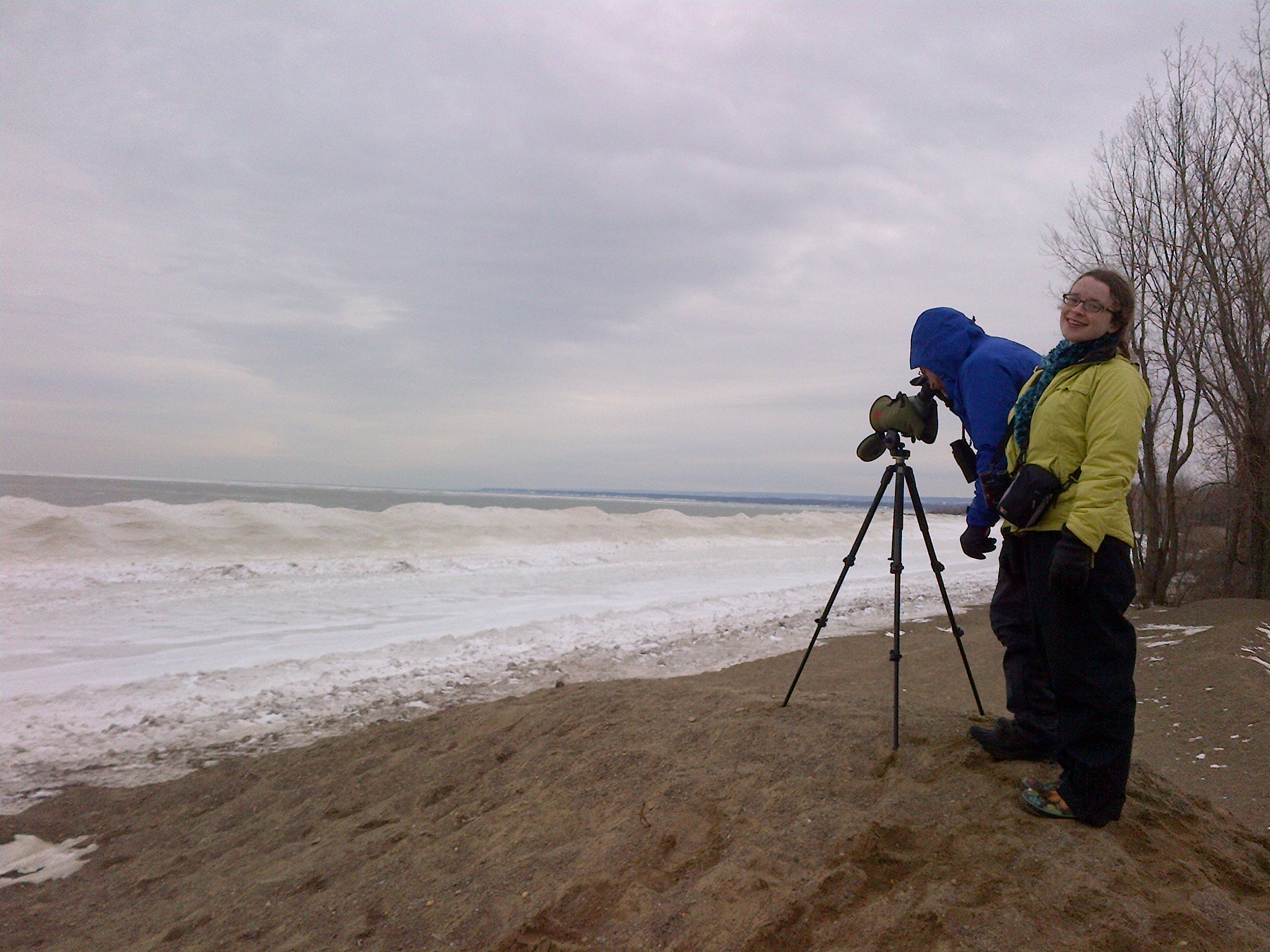
On January 5, Ron, Rachel and myself went to Presque Isle State Park (Erie, PA) with the goal of seeing Snowy Owls.  We saw a total of six after spending a few hours there!  What was most interesting to me was the way they were spread out, each one alone, out on the ice.  They seemed to be spacing themselves quite far apart, like a mile or so.  Now, normally when you see animals spacing themselves out it’s because they are defending territories in order to protect resources for themselves.  In this case, each owl just had a vast expanse of bumpy snow and ice, with plenty of wind and cold air to go with it.  They aren’t getting any food from the ice- no rodents under the snow  out there, that’s for sure. The other cool creature we saw was a coyote, curled up like a hockey puck, way out on the bay ice.  Why would the coyote choose to sleep way out there in the open rather than finding a more sheltered, hidden spot on land?  I was concerned that the coyote might be injured or ill, but in looking at it through the scope, he would periodically lift his head, yawn, look all around flicking his ears to pick up distant sounds, then put his head back down.  So he was fine.  

After pondering this for a while, my thought is that the owls are out there for the same reason the coyote made the choice to take a nap way out there. It’s easy to see something coming towards you.  And not much is likely to bother you way out there.  Also, from what I’ve read, the owls tend to rest during the day and feed at night.  So I guess they are out there resting up and enjoying the cold.


Categories: Uncategorized | Tags: , , | Leave a comment

Create a free website or blog at WordPress.com.